a quiet place …


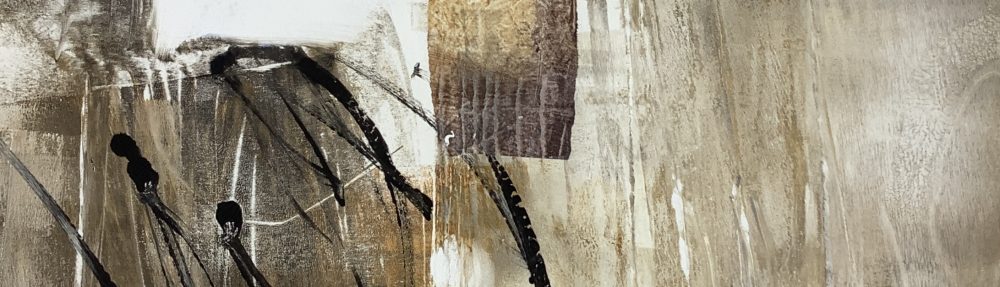
A quiet place. Acrylic/ink on canvas board. Mari French 2015

A quiet place. Acrylic/ink on canvas board. Mari French 2015


I painted these two new Saltmarsh works just recently and they’re now at the framers in preparation for my small solo show at Fineline Frames Gallery, Creake Abbey, North Norfolk, this September.

I admit I’m quietly pleased with them. I’m so enjoying working on this series and excited by the way my interpretation of the Saltmarsh is developing. I can’t wait to see them framed.

For those of you not familiar with my obsession with this subject, this is what I’ve written as an intro to the blurb for the exhibition:

Mari French’s current work is inspired by the ever changing beauty of the saltmarsh coast of North Norfolk. Since moving to Norfolk six years ago, she has spent many hours walking and sketching around Thornham, Brancaster and Burnham Overy Staithe, in particular. This has culminated in an ongoing series of mixed-media abstracted landscapes, which will eventually form a larger body of work on the theme of saltmarsh. Her aim is to suggest the shapes, colours and textures of the saltmarsh that capture her interest – old staithes, channel markers, creeks, grazings, breakwaters, tidal marks, reedbeds – and place them in the wider coastal environment.

My exhibition starts on Saturday 5th September and runs for the whole month. Tues – Sun 10am – 4pm.

Fineline Frames Gallery, Creake Abbey, North Creake, Fakenham, Norfolk NR21 9LF.

 
Liminal space. Acrylic/ink on canvas board. Mari French 2015

Liminal space. Acrylic/ink on canvas board. Mari French 2015


tidal tales …

still painting these small Saltmarsh works… these two are the latest.

I’ve tried working them on stretched canvas, but so far I prefer the way the grain of these canvas boards gives a broken texture to the colour and the light. (The slight pink cast in bottom right of the photos is due, unfortunately, to the bright pink case on my iPad which I took the photos with!)


Saltmarsh. Acrylic/ink on board. ©Mari French 2015

Saltmarsh. Acrylic/ink on board. ©Mari French 2015


Saltmarsh. Acrylic/ink on board. ©Mari French 2015

Saltmarsh. Acrylic/ink on board. ©Mari French 2015

a saltmarsh is born…

Subsequent tides. Mixed media on paper. © Mari French 2015

Subsequent tides. Mixed media on paper. © Mari French 2015

The following is an extract from an interesting post I recently came across, giving a useful insight into the saltmarsh coast of Norfolk, the subject of my current artworks :

November Saltmarsh

In Norfolk there are amazingly few habitats which are self-forming and self-maintaining – which therefore require no intervention from conservationists to keep them as they are – and almost all of them are associated with the sea, its winds, its waves and its tides.

… the tide … helps make two fascinating and oft-ignored Norfolk habitats. Two of the wildest, least human-led habitats in Norfolk at that: mudflat and saltmarsh. In areas sheltered from the intense energy of the waves, such as enclosed bays and the harbours behind spits, the finest sediments in the water – tiny particles of silt – are deposited at the top of the tide, where the water has least energy. These particles cling to one another and where they are not shifted by subsequent tides they form a tenuous, easily-moved mudflat. Where conditions allow, filamentous algae colonise the mudflat, followed by what botanists call glasswort and in Norfolk we call samphire. These plants stabilise the flat and encourage more silts and clays to settle.

A saltmarsh is born.

Nick Acheson, Norfolk Wildlife Trust

norfolkwildlifetrust.blogspot.co.uk

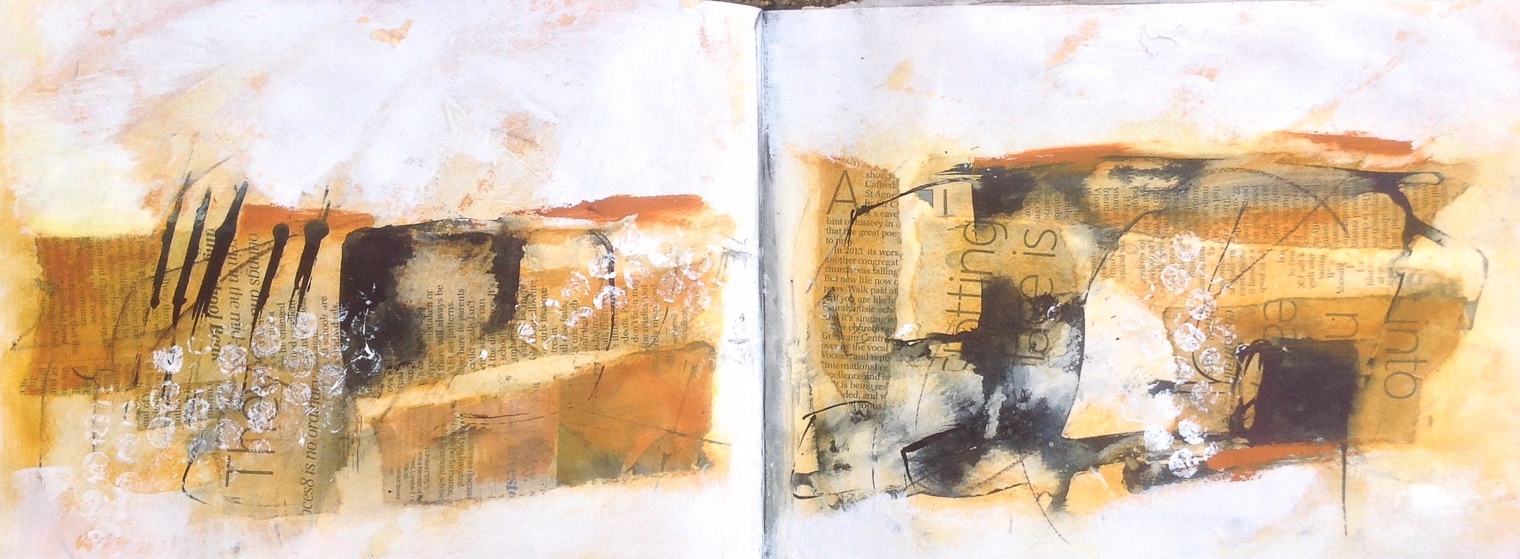
Overy Marsh. Workbook spread. © Mari French 2015

Overy Marsh. Workbook spread. © Mari French 2015


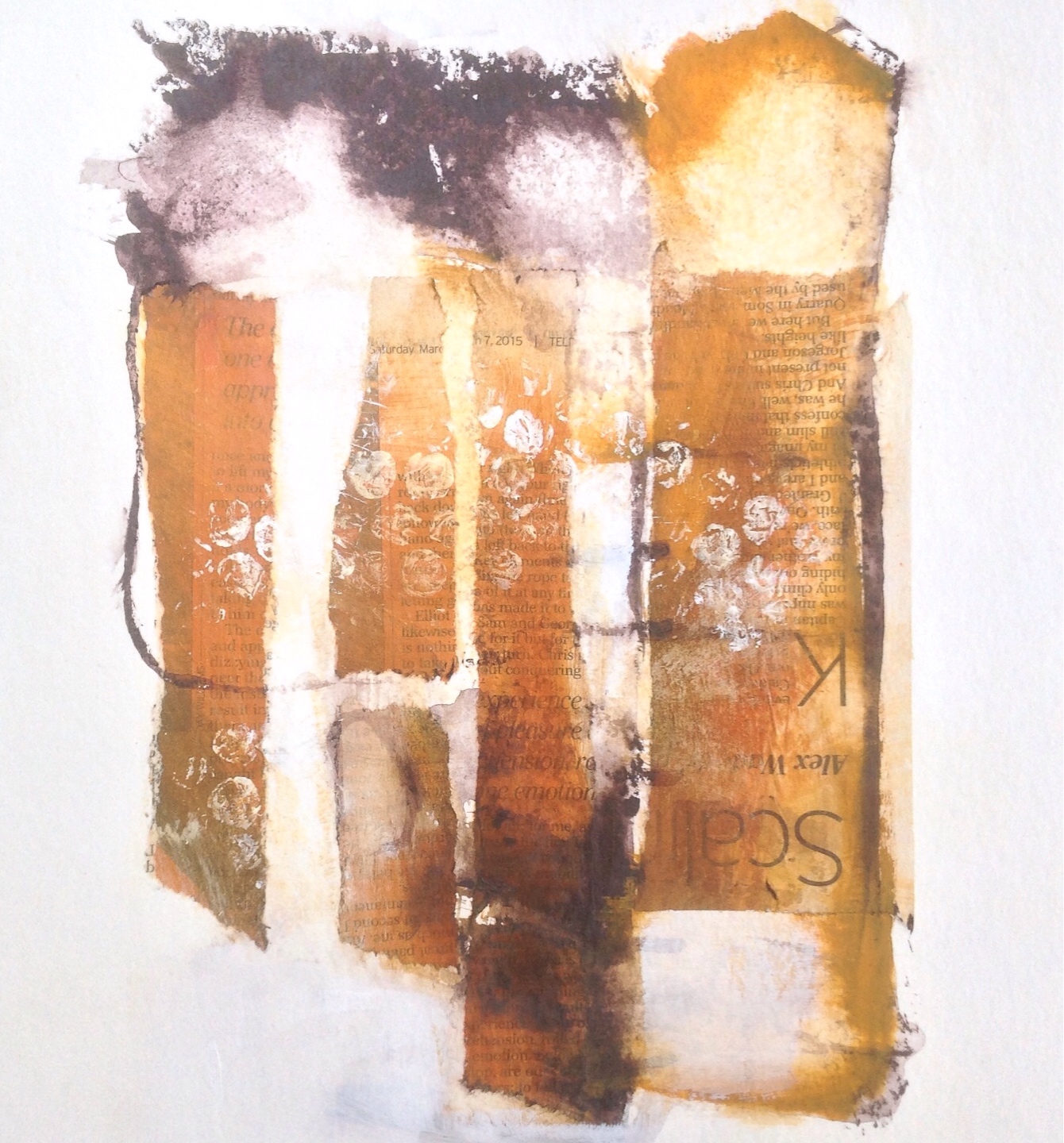
But here we are. Overy Marsh. Mixed media on paper. © Mari French 2015

But here we are. Overy Marsh. Mixed media on paper. © Mari French 2015