painting with pixels …

I’ve rarely painted domestic interior subjects, but i enjoyed this… the warm glow of the lamp, the loose treatment of the jug and flowers. I may try it with actual paints sometime… 

I created these using the iPad app ArtRage. I find ArtRage a really good painting/sketching programme (cheap for iPads but costing more for the comprehensive desktop version). It’s the best painting app I’ve come across so far, with lots of control and choice over materials, tools, colours etc., even the size and type of grain for the work surface. I sometimes use the Sensu brush I recently treated myself to, which adds a new dimension to the experience, but is not necessary, a good stylus will do. 

It took me some time to get used to this painting app – my early efforts were more like schoolkid graffiti until I had chance for some intensive practice back in September while passing time invigilating at my own exhibition in King’s Lynn. (An earlier post shows results from that practice if you’re interested).

Reading_lamp_iPad_sketch_Mari_French_2014.JPG

Reading lamp. iPad sketch. Mari French 2014

To get the effects here I was using a largish flat brush with the with the autoclean option on and instadry option off. I like to play around with various combinations of options and when I get one I like I save it as a preset, so I can use it again. I’m just amazed how pixels can be made to react like wet paint, blending, smudging – love it!

A consideration occurs to me, however, as to how the digital painting will effect my usual ‘physical’ painting/sketching practice. It may (hopefully) free up my brush technique and use of colour for instance… 

or… 

will I find myself reaching for the ‘undo’ option which is so useful on the digital app (as is the layers facility, where various layers can be added to the work in progress and turned on and off at will to view the results). I remember with some amusement, when I worked quite intensively on an Apple Mac as a graphic designer some years ago; I would often find myself, when at home, rearranging furniture or perhaps pictures on a wall and then be mentally grasping for an ‘undo’ for the easy way to set it back as it was!  
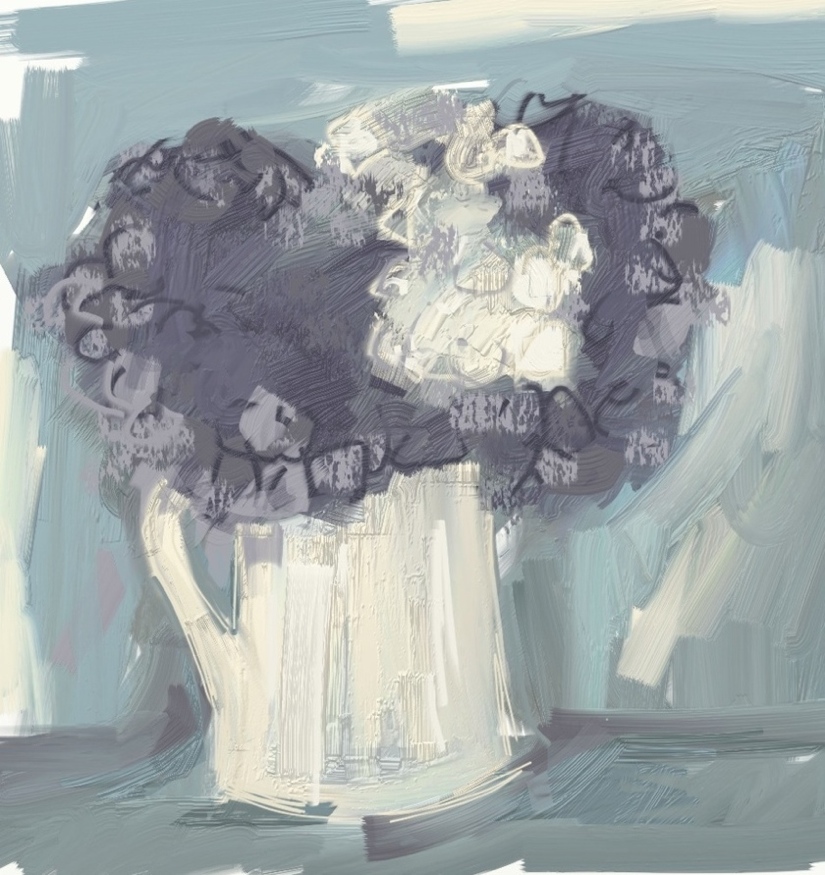
hydrangeas. iPad sketch. Mari French 2014.

round like a circle …

I’ve noticed I use the circle quite often in my artworks. Recently I’ve been playing around with mixed media – tissue, acrylic, inks – without specific subject matter in mind, as a sort of midwinter exercise. It’s good to take the pressure off, when deadlines permit. 

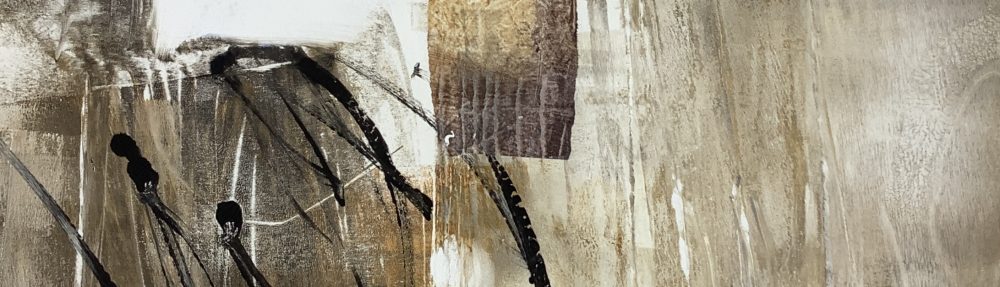
Anyway, although these are possibly still works in progress, while pondering them I started to muse on the nature of my marks and, as I said, the prevalence of circles in them (see also the present header image) …

Untitled, mixed media on board. Mari French.

Untitled, mixed media on board. Mari French. 

Some of mine fairly obviously represent the sun and moon, especially as many of my paintings are inspired by the landscape; also ponds (circular ponds are prevalent in my local agricultural landscape); mine stacks (aerial view) or holes in the ground in my Cornish works. 

But aside from literal interpretations, it can be interesting to see what alternative meanings the circle might represent … the more abstract connotations. Look up ‘circle as symbol’ online and of course there are a multitude of entries. I’ve quoted just a few here which I find worth considering. I particularly like ‘the cycle of time’ ‘the great rhythm of the Universe’ ‘potential’ and ‘infinity’ …

The circle is a universal symbol with extensive meaning. It represents the notions of totality, wholeness, original perfection, the Self, the infinite, eternity, timelessness, all cyclic movement, God (‘God is a circle whose centre is everywhere and whose circumference is nowhere’ (Hermes Trismegistus)). As the sun, it is masculine power; as the soul and as encircling waters, it is the feminine maternal principle. “It implies an idea of movement, and symbolizes the cycle of time, the perpetual motion of everything that moves, the planets’ journey around the sun (the circle of the zodiac), the great rhythm of the universe. The circle is also zero in our system of numbering, and symbolizes potential, or the embryo. … http://www.umich.edu/~umfandsf/symbolismproject/symbolism.html/C/circle.html

The Circle is the most common and universal signs, found in all cultures. It is the symbol of the sun in its limitless or boundless aspect. It has no beginning or end, and no divisions, making it the perfect symbol of completeness, eternity, and the soul: The circle is also the symbol of boundary and enclosure, of completion, and returning cycles… http://symboldictionary.net/?p=1914

Circles commonly represent unity, wholeness, and infinity. Without beginning or end, without sides or corners, the circle is also associated with the number one…

Protection. Circles are often seen as protective symbols. Standing within a circle shields a person from supernatural dangers or influences outside of the circle. Conversely, a circle can also be containing, keeping that which is inside from been released.

Sun Symbols. Circles are frequently used as sun symbols, as well as representing things associated with the sun. The astrological symbol of the sun is a circle with a dot in the middle. The same symbol is often used to represent gold, which is strongly associated with the sun.

The Element of Spirit. The element of spirit, seen as an element equal or superior to the physical elements of fire, air, water and earth, is commonly represented by a circle.  http://altreligion.about.com/od/symbols/ig/Geometric-Shapes/Circles.htm

Untitled, acrylic/mixed media on art board. Mari French.

Untitled, acrylic/mixed media on art board. Mari French.


Collagraph print, Mari French.

Collagraph print, Mari French.


hanging around …

a ‘work in progress’… acrylic/mixed media on canvas, 80x80cm … another in my explorations of the abstract imagery of the mining area near Cape Cornwall. You might have noticed the inverted commas back at the start of this post … well … I can’t decide yet if I should do much more to it or what the nature of the further work should be. A common dilemma for artists I realise.

But, although I like how it’s looking just now, I’m also aware that it’s a bit of a crossover, with a large abstract section but also more representative upper parts… and this is why it’s been hanging on my studio wall for a few weeks now. Do I leave it largely as is, perhaps with some subtle colour toning/glazing in the orange lower areas; or try to reconcile the abstract/representative areas? Is it acceptable to leave it as is? I’m aware as an artist, this is ultimately down to me, but constructive opinions would be gratefully welcomed.

20131208-211725.jpg