First of all, I have Sarah Fincham to thank for inviting me to take part in this Round the World Blog Hop. Artists and writers worldwide are involved, with each inviting a couple of others to participate. The idea is that each blog post links back to the previous participant and forward to the invitees, creating a kind of chain event. We’ve all been asked to consider the following list of questions about our art and creative processes. Anyway, here goes! • What am I working on? • How does my work differ from others in its genre? • Why do I write / create what I do? • How does my writing / creating process work?
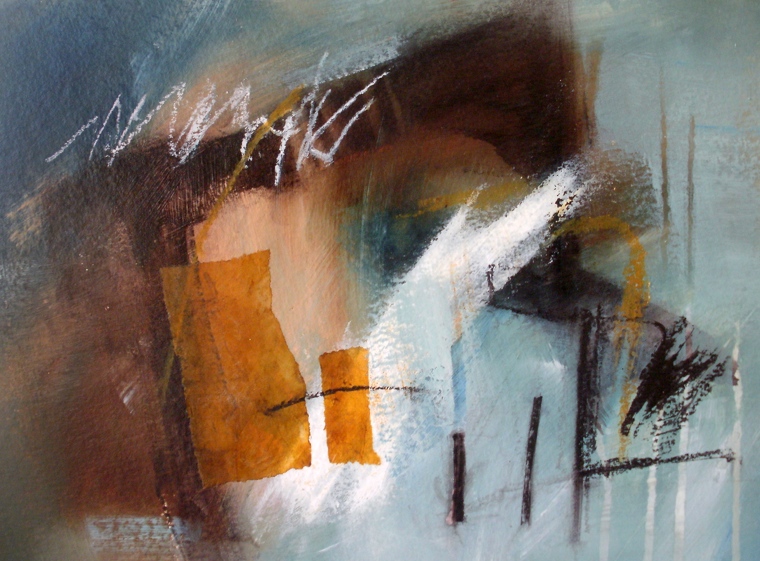
Reed beds and bird calls. Mixed media on paper. Mari French.
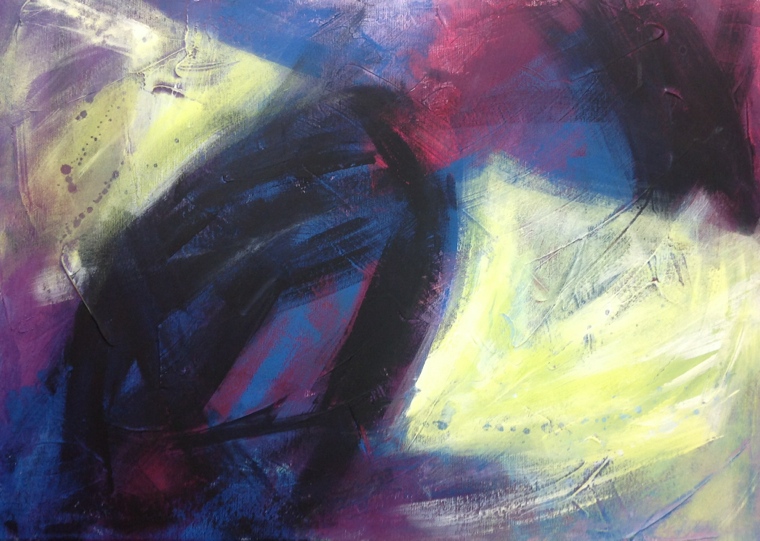
What am I working on? As usual, several themes/media are occupying me recently. I’m producing more in my occasional series of small mixed media on board responses to the salt marsh coast of north Norfolk (see image above). I more usually walk around Thornham area with my sketchbook, but last weekend I ‘discovered’ Burnham Overy Staithe marshes under a dark rain laden sky and I have to go back! Back in the studio, with the sketches put away, I try to get across that feeling of exhilaration at the open skies and land, the light bouncing back off the tide as it fills the creeks, the calls of geese and waders, the breeze in the winter reed beds. Another type of work occupying me just now are large-ish abstract canvases of gestural brush strokes mainly influenced by the coasts of Cornwall and Norfolk. When I finished the canvas ‘Summer Harbour’ (see image below) I knew by the thrill of excitement I felt that I had had a kind of break through in my abstract landscapes. This was how I wanted to paint! Wild fast brushwork with oil pastel or ink marks adding to the visual language.

Summer Harbour. Acrylic on canvas. Mari French 2014
I also have a few works in progress on a theme I’m currently interested in, prompted by the Tinners’ Coast area of Penwith, Cornwall, which I explored, sketched and produced studies of on my residency at nearby Brisons Veor back in March this year. My earlier industrial landscape abstracts of the mine ruins along that coast have recently led to more intimate studies of the rusted and decaying interior of the huge engine sheds and the small derelict dynamite store at Priests Cove. I’ve always been attracted to texture and decay in buildings and this was a rich source I’ll be calling on for some time to come.
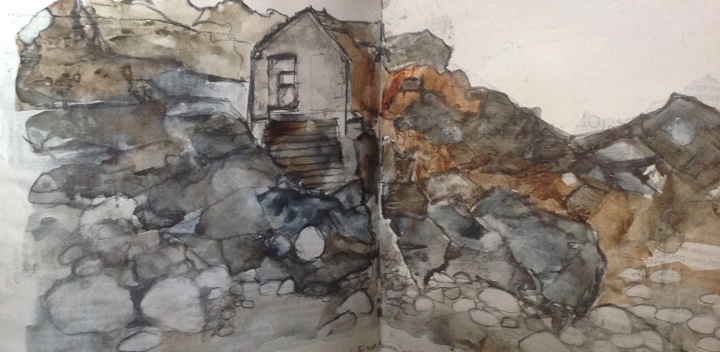
Old dynamite store, Cape Cornwall. Sketchbook. Mari French.

A Safer Distance series. Mixed media on panel. Mari French 2014

Rust Idol (ii). Mixed media on paper. Mari French 2014
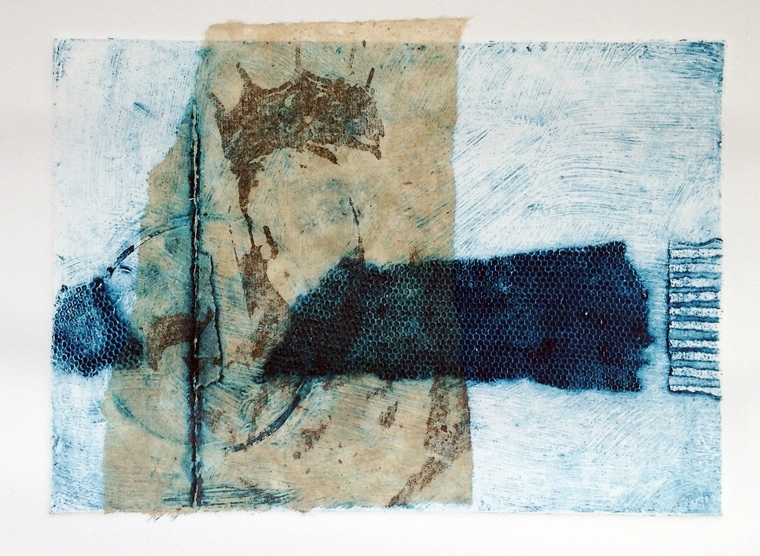
In between painting bouts I often have a complete change by creating Collagraph prints – textured, limited-edition images hand printed on a small etching press from a collaged plate. I sometimes add Chine Colle (scraps of tissue or handmade paper). I’ve recently begun transferring high contrast black and white images from my own photos onto the chine colle (a favourite of mine is the exquisite Lokta paper) to add a further dimension of interest.

Numinous. Collagraph print with transfer on chine colle. Mari French 2014.
How does my work differ from others in its genre? Tough question! I’m not sure that it does other than the obvious way in which each artist inevitably has their own style. The abstract landscape art I most admire seems to have distilled its forms to a unique visual language (e.g. Barbara Rae, Jane Lewis). Being self-taught I’m still developing my own visual language, trying to produce a distillation of the landscape. It’s frequently said that there’s a lot of movement and texture in my work, and especially a sense that the more you look at one of my pieces, the more you discern. That suggestion in the layers and textures, the exposure of the underlying painting, perhaps that’s how my work differs? It leads the imagination of the individual viewer into personal interpretation.

Priests Cove (ii). Mari French 2014
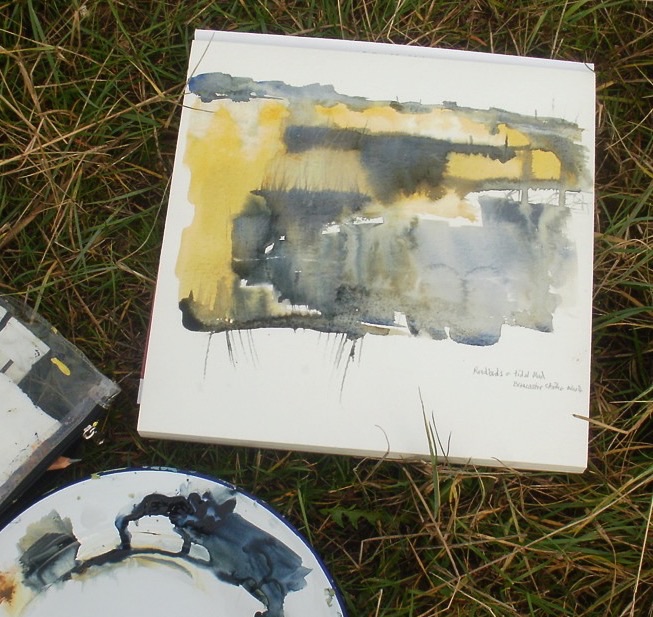
Why do I write / create what I do? That’s an easier question to answer – I can’t not! This compulsion to express on canvas or board the exhilaration I feel looking at the way light breaks through a cloud over a field, the colours of a wild crashing wave, the ancient patina of decayed buildings, is all-consuming. Much of the time it falls short of what I’m trying to say, but the absolute satisfaction of standing in front of a work that expresses what I felt, that succeeds for me… that’s why I paint. I’m drawn by the effects of light and weather on the landscape and the colours and textures produced. I’ve been fortunate for a few decades now to live in some of the most beautiful places in the UK. But I’m not inspired so much by fine weather and green fields. It’s the days when rain or hailstorms sweep like curtains over a bay, clouds chase their own shadows over a hill; days when the sea is smashing into rocks, or the autumn sun lights up the reed beds on a salt marsh… those days fill my head with images for future work. There is one other aspect and that is sheer pleasure in the medium, the way materials – ink, paint, oil pastel, acrylic – respond and interact with each other and the surface. How does my writing / creating process work? It starts with my sketchbooks I suppose. Sometimes with just my eyes, striving to capture and take in a scene I’ve found compelling, even if it’s just a fleeting moment. This can be a bit hair-raising if out driving as I try not to swivel my head too much till I can pull over. Artist friends of mine often joke that we should have car stickers saying ‘Warning, Artist driving!’. Sketching out in the field (which is where 99% of my sketching takes place) is necessary for the initial interpretation of what has caught my eye. I enjoy it immensely and it trains my observation skills.

Reed beds and tidal mud. Watercolour sketch. Mari French 2014
However, I very rarely paint directly from my sketches. I often think life might be simpler if I could. I’ve always found that way of working inhibiting; the freedom and looseness was in the original sketch, I can’t replicate that and still maintain the freshness. But the impression is stored somewhere in my brain, eventually subconsciously influencing my work. My creative process can be pretty physical. I usually start a work by laying texture paste on a canvas, or pasting tissue to a watercolour board (Daler Saunders Waterford are very good), without a clear idea of the final image. I get rid of the whiteness by loosely and vigorously applying a couple of colours of paint or washes of acrylic ink, allowing accidental mixing of the media. This is very much an instinctual phase and I try not to overthink the process. I like to build up layers and areas of paint or other media, wiping back through the layers, splashing with water here and there. I enjoy allowing the serendipity of accidental effects free rein. Sometimes, especially if it feels like it’s not working, I’ll take a canvas over to the sink and spray and splash it with plenty of water till the diluted paint is running in places. I’ll then ‘catch’ it by blasting it with the hairdryer, which halts the process to a certain extent, and I’ll wipe back here and there. Then I continue working onto the resulting altered surface.
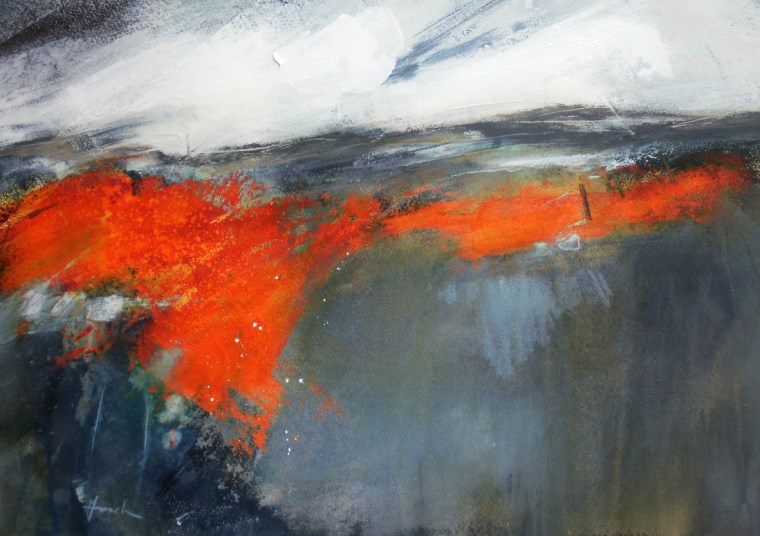
Fire and Earth. Mari French 2014
Somewhere in these latter stages I step back and consider the image. Eventually it will suggest a land form or image that reminds me of something I’ve seen or sketched. This is when I start to ‘guide’ the process more, make more deliberate marks and areas of colour and gradually the work comes to a conclusion. If it doesn’t suggest a particular image, I’ll develop the composition into a pure abstract. Sometimes though, I come to a grinding halt partway through the artwork, unsure of where it’s going or what I should do with it next, in which case I’ll put it to one side to come back to at a later date. I can often have three or four works hanging around like this, waiting for me to be ready to work further on them. I used to think this was a failing on my part, but I’ve come to realise it’s a valid way of working for me, if often frustrating, and that many artists do the same. Of the several artists I invited to take part in the next ‘hop’, which will be published on 12th December, two were unfortunately unable to take part due to personal circumstances, and I haven’t heard back from a third. Artist Elaine Phipps was eager to get involved but unfortunately unable to participate due to family commitments. I can recommend her lively blog though, with her abstracted paintings of landscape, coast and trees; and I particularly appreciate it when she shares her workbooks. One artist I invited who will be participating is Mo Teeuw, an accomplished plein air oil painter of scenes as diverse as the Suffolk countryside, Venice and Morrocco. Mo’s light-filled paintings beautifully capture the variety of the countryside and city. She is self taught and says she has learnt a lot from teaching others. She recently broke her ankle badly but that hasn’t stopped her carrying on painting outdoors from her wheelchair till it heals!
An extra note to say that since this was posted, Mo Teeuw has unfortunately been delayed in posting her own blog hop. Hopefully she’ll be able to add hers soon.






 Mari French RI : contemporary artworks