abandoned colour …

a selection of sketches from a week in Cornwall in September, spent exploring the moors, coast, ancient Bronze Age remains and the other-worldliness of the abandoned tin and copper mines in the Penwith area.

Towards Rosewall Hill, Cornwall

Towards Rosewall Hill, Cornwall.

These sketches were made on the spot, (in varied weather) in my current favourite sketchbook – a Moleskine watercolour sketchbook. The paper weight is robust enough to stand up to the deluge of water I usually flood each page with and I prefer the landscape format over the A5/A6 sizes sketchpads and books tend to come in.

Apart from my usual use of wet-in-wet watercolours and pencil, I was trying out the Derwent Inktense blocks which I’ve recently discovered; I love their immediacy of colour, their smudgy intensity, especially in the darker colours, like the plummy colour shown in the sketch above.
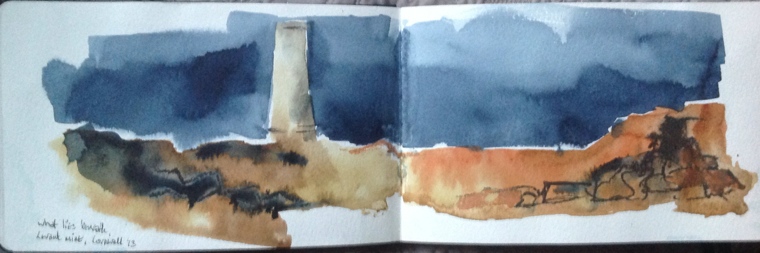
Mine stack at Levant, Cornwall.

Mine stack at Levant, Cornwall.


Verdigris leaching from cliff, Levant Mine.

Verdigris leaching from cliff, Levant Mine.   

The colours of the earth around these mines where the ores carpet the surface, and the copper verdigris leaches from the sea cliffs below the mines, have to be seen to be believed! It looks just like a giant has flung pots of paint around with abandon.

Mine stack, Levant Mine.
Mine stack, Levant Mine.


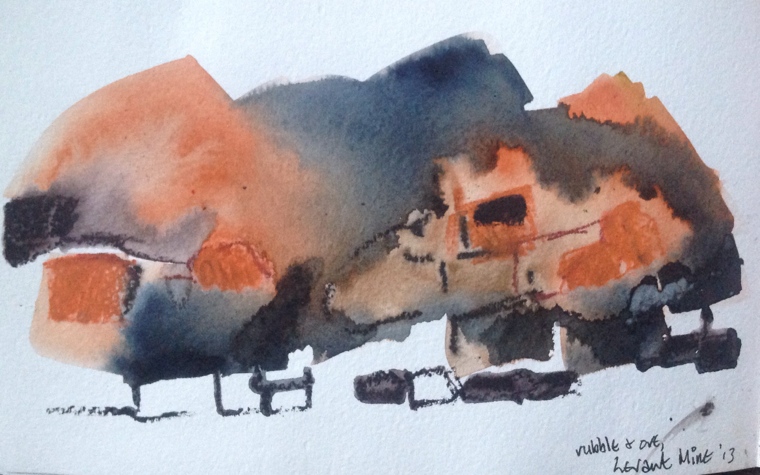
Rubble & ore, Levant Mine.

Rubble & ore, Levant Mine.

There is enough visual inspiration in this industrial landscape to warrant returning and spending much longer gathering material for a whole series of work. I’d love to do just that.

Rock formation, Levant.
Rock formation, Levant.


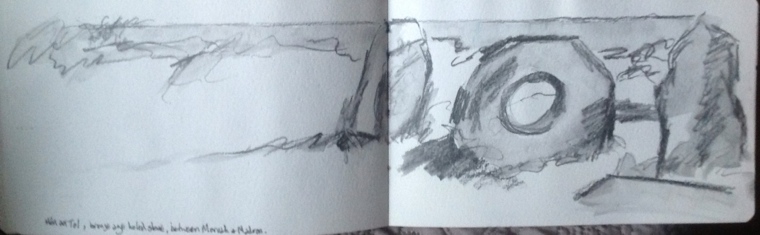
Men an Tol, near Morvah

Men an Tol, near Morvah


Rainclouds over Porthmeor bay, St Ives, Cornwall.

Rainclouds over Porthmeor bay, St Ives, Cornwall.
 

grit & glue … collagraphs & carborundum

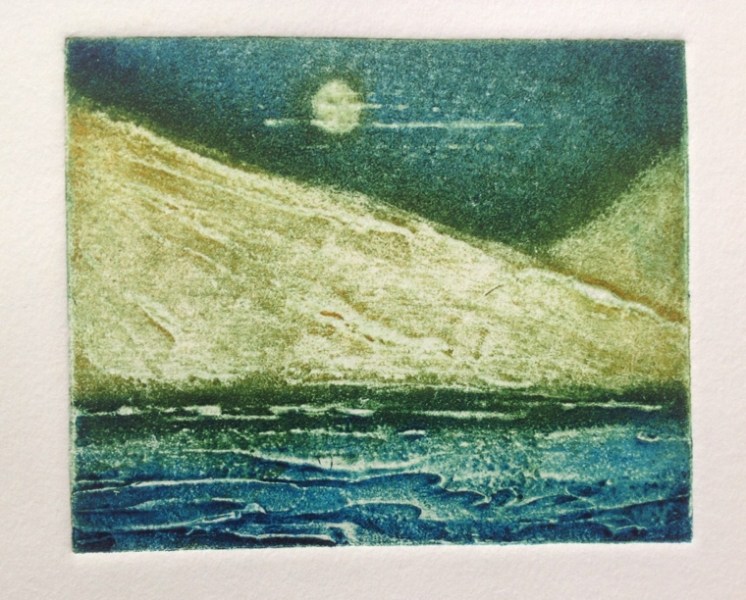
Moonlit lochs © Mari French 2013. Collagraph & carborundum print.

Moonlit lochs, collagraph & carborundum print. © Mari French

I recently attended another two day printmaking workshop, this time on Collagraph and carborundum, with tutor/master printmaker Laurie Rudling. The venue was at Cley on the north Norfolk coast, and was part of the Cley 2013 art festival.

This was the second of Laurie’s printmaking courses I’ve attended, the first being two years ago (see previous post). I needed a refresher because by the time I got a press and a studio to use it in I had lost all confidence in using it on my own (more the technicalities of the press rather than the actual printmaking … stupid, I know).

Basically collagraphs are prints made from collaged ‘plates’ – usually just thick card, layered with many different everyday materials eg. wallpaper, plants, cloth, tissue, string, ad infinitum, glued to the base. The plates are then sealed with several coats of varnish and inked up for printing. The addition of carborundum (a type of grit) enables large areas of denser colour (see the mountain area in the larger print above).

Although some prints, such as linocuts, woodcuts etc, can be obtained by hand pressure to a certain extent, collagraph prints do really require a press due to the complexity of the image and need to force the paper into the gaps between the collaged materials.

The small prints below were created by painting with PVA glue on sandpaper block, as simple as that and yet it is possible to achieve a range of interesting effects. I particularly like the sea area in this one. Overturning the usual notions of colour use in the second inking up gave an interesting result, almost an Arctic night image.

Sandpaper & glue print © Mari French 2013

Sandpaper & glue print © Mari French 2013

Sandpaper & glue print © Mari French 2013

Sandpaper & glue print © Mari French 2013

Anyway, I aim to get my press up and running this week, it would be great to have some prints to put in my solo show at Greyfriars Art Space in King’s Lynn in September alongside my acrylic/mixed media works.

For more detailed information and inspirational images on Collagraph printmaking one of the best books on the subject has to be ‘Collagraphs and mixed media printmaking’ by Brenda Hartill and Richard Clarke.

sitting comfortably …

Just a few sketches from this week’s visit to my favourite stomping ground … Thornham salt marsh on the Norfolk coast. In celebration of the Queen’s jubilee a new bench has been conveniently sited facing out to sea along the creek. HM had her photo taken on her new bench recently with some of the villagers (Sandringham is nearby).

Thornham salt marsh. Mari French

Thornham salt marsh

It’s a popular spot for locals to rest, but despite the bright sunlight there was a cold northeasterly (there has been most of the year so far), and I had the bench to myself for an hour and could spread out. What a luxury not to be perched on a cold rock or on my waterproof mat on a tussock of grass trying not to lose my brushes or pencils in the grass. I’ll be getting soft 🙂

Emerging sun, Thornham Creek. Mari French

Emerging sun, Thornham Creek.

There was a very low tide… I’ve never seen the mud in the creeks so dry and pale. The blonde smudge of sand reflecting the sun across the near horizon seemed larger and closer than I’ve seen it before, with the channel marker posts standing out clearly. 

Changing light, Thornham. Mari French

Changing light, Thornham.