collagraph experiments …

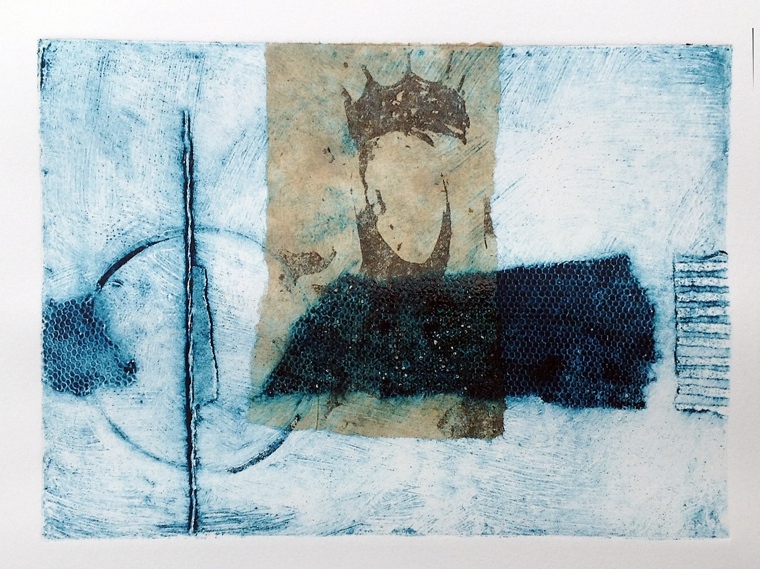
Collagraph with transfer and chine colle.

Collagraph with transfer & chine colle. Mari French 2014

This week’s experiments with printing collagraphs… incorporating printed material (both found and self created on Lokta paper). 

The subject matter in these is deliberately more abstracted than my recent collagraphs. The plate was mount board with texture paste brushed on (perhaps a little too much on the last one below ‘Fathoms’). I use cerulean blue ink a lot, but mixed this time with a little raw umber, which gives a lovely depth of colour.

Really enjoyed producing these and I’ll be experimenting further along these lines. I’ll keep posting the results.

Collagraph with transfer and chine colle

Collagraph with transfer & chine colle version 2. Mari French 2014


Fathoms. Collagraph with transfer & chine colle. Mari French 2014

Fathoms. Collagraph with transfer & chine colle. Mari French 2014


hot off the press…

Printing collagraph with Chine Colle. Mari French 2014

Printing collagraph with Chine Colle. Mari French 2014


I recently moved the printmaking side of my art business to a new venture in my home village of Harpley, Norfolk. Norfolk Design Gallery is where glass artist Fi Kilpatrick, architect Lara Hall and myself work at our respective crafts and display and sell our own work and that of other makers and artists. 

I’ll still be painting from my lovely rustic studio but printmaking at the new place a couple of days a week. I’ve been getting set up the past few weeks but have been creating and printing collagraphs the past week. 

I’ve just tried out the technique of Chine Colle, which is where thin piece/s of coloured paper, such as Japanese handmade papers, are placed onto the inked-up plate with the addition of a little dilute paste and run through the etching press. The paper then becomes laminated to the printing paper with the inked image over the top. It can add an interesting dimension to a print. 

My first results you can see here. I’ve used a lovely buff coloured Lokta paper, which has small flecks of natural materials in it, for the chine colle. This was also the first time I’d used shellac varnish (also known as Button varnish) in thin coats to seal the plate before inking, instead of the water based DIY varnish I usually use, as I’d read it can allow more of the texture to be retained.

This particular image is based on sketches I produced on my recent art residency at Brison’s Veor, Cape Cornwall.

 printmaking_at_Norfolk_Design_Gallery_Mari_French_2014.JPG


Collagraph with Chine Colle. Mari French 2014

Collagraph with Chine Colle. Mari French 2014

A couple of other collagraph plates, below, that I’ve recently been working on… I prefer the actual plates to the results sometimes!
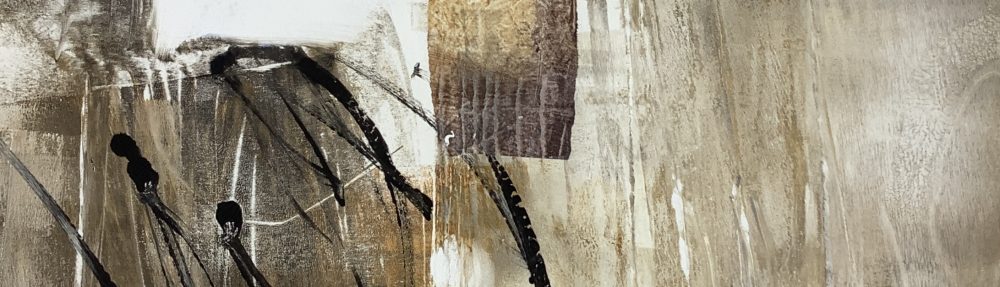
Collagraph plates. Mari French 2014
Collagraph plates. Mari French 2014
 

the earth bleeds …

Regular followers of this blog may remember my previous posts describing visits to the tin mining area of Penwith, near Lands End in Cornwall and the almost alien industrial archaeology there. If not, you can check them out here, here and here.

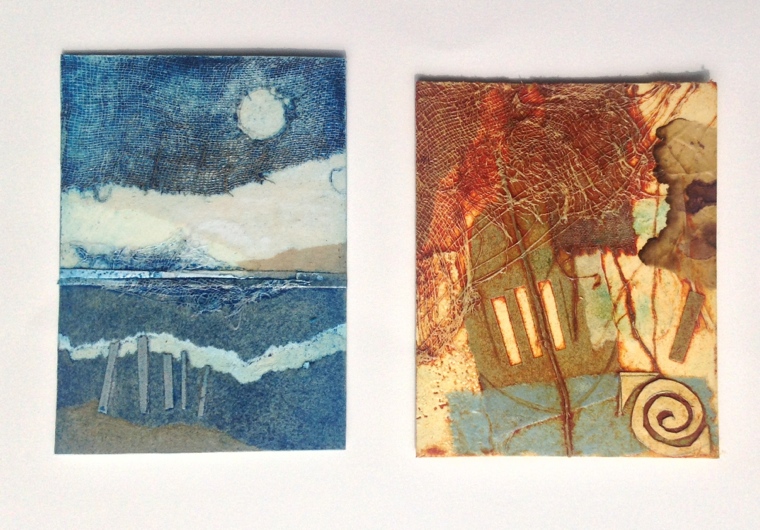
Below are the two most recent mixed media artworks I’ve produced on this theme. Again I’m exploring my response to the red iron oxide covered ground, the bright turquoise verdigris leaching from the copper adits where they emerge from the sea cliffs below the mines, the stark finger-like stacks pointing skywards.

20131111-171106.jpg

Acrylic paint, tissue, acrylic ink and inktense blocks have all been used. The support was Daler watercolour board, which will take quite a lot of wet media if adequately taped down.

It’s an absolute joy to be an abstract artist and come across such rich source material…

I have to go back …

20131111-183927.jpg