new greetings cards…

art cards © Mari French 2011

art cards © Mari French 2011

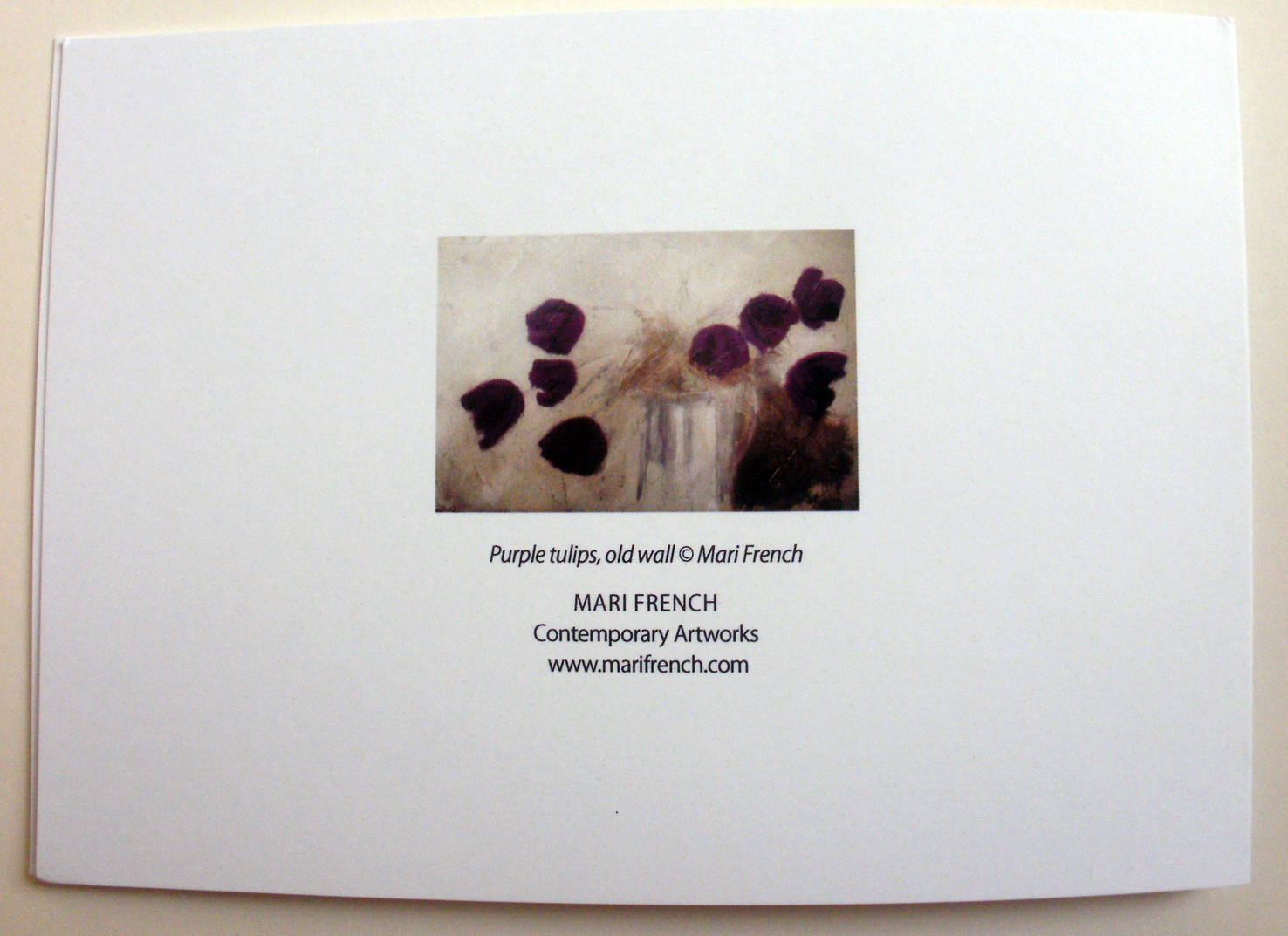
I’m now pleased to be able to offer 3 quality printed art cards showing my work … a chance to own a little piece of my art or send as greetings cards or notecards.
Two landscapes and one of the ever popular purple tulips paintings.
Each is blank inside and cello wrapped with envelope. (The back of each card has a small printed image of the cover print).

Currently retailing at £2.50 each I’m offering a set of 3 for my blog readers and facebook followers, for £6.00 inc p&p.
Paypal accepted or cheques, please ask me for details.

art cards © Mari French 2011

art cards © Mari French 2011

pressing matters…

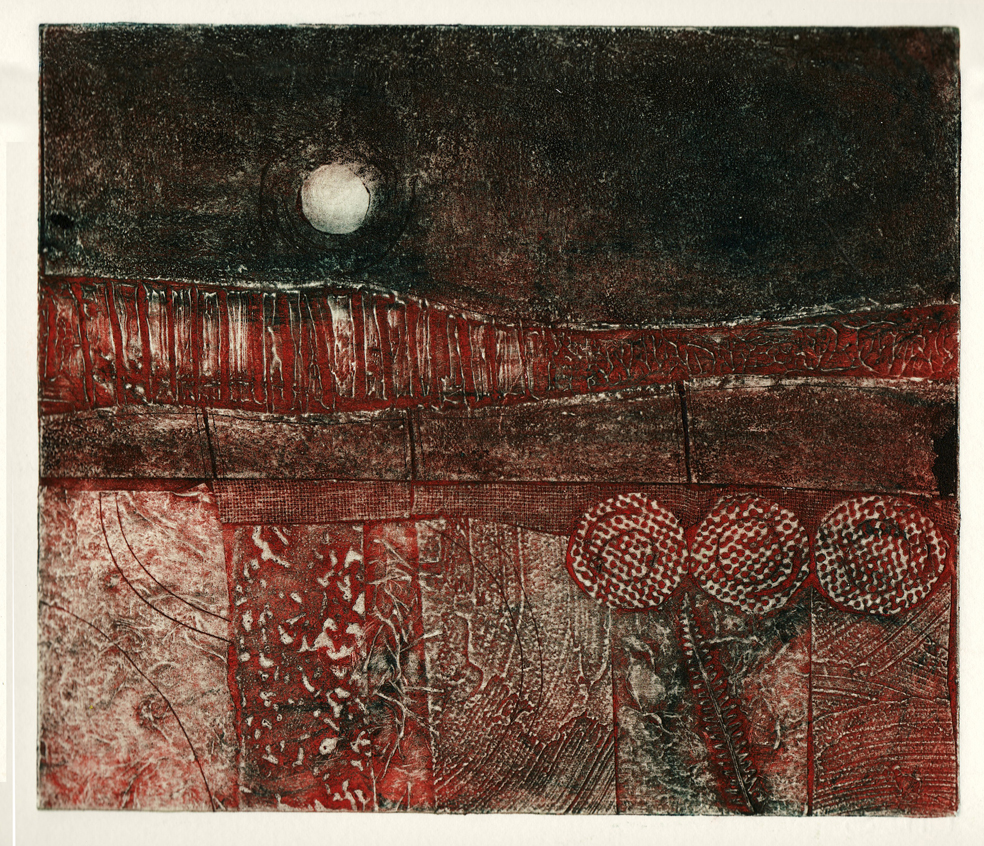
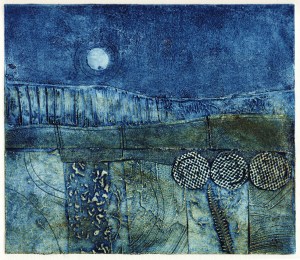
Harvest moon 2 (collagraph) © Mari French 2011

Harvest moon 2 (collagraph) © Mari French 2011

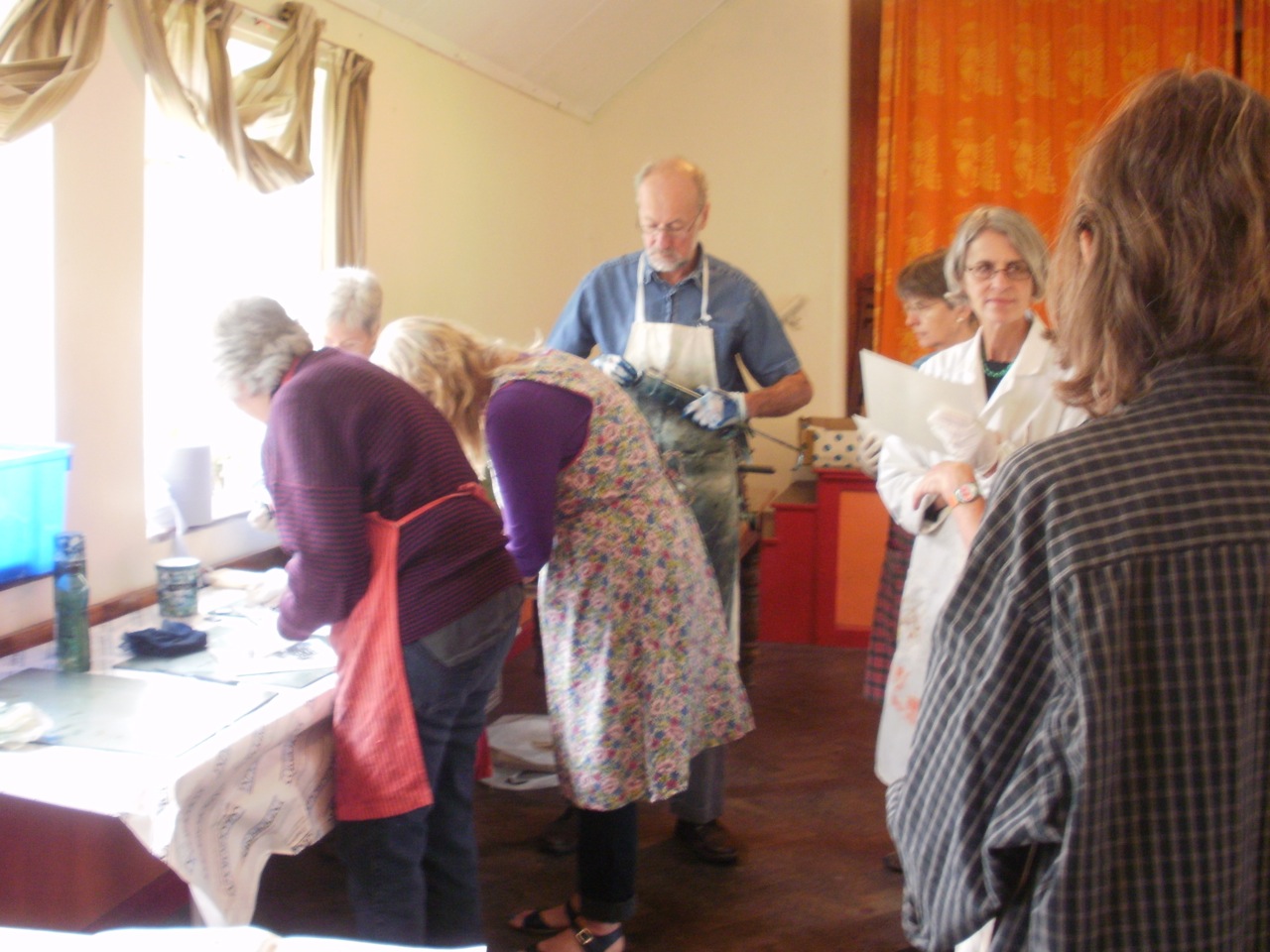
Last weekend I enjoyed the most inspiring and creative weekend collagraph printmaking workshop with Laurie Rudling at Salthouse, north Norfolk. The workshop was incredibly good value for money, being heavily subsidised as part of the Salthouse 11 art project. Laurie is an incredibly professional printmaker and effectively passes on his knowledge in an enthusiastic, instructive and effective way, packing a lot into the two day workshop.
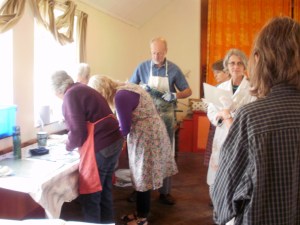
Collagraph workshop with Laurie Rudling (© Mari French)

Collagraph workshop with Laurie Rudling (© Mari French)

Collagraphs are a method of (intaglio) printmaking created by collaging materials of a similar thickness, eg bits of sandpaper, wallpaper samples, muslin cloth etc, onto a simple (in this case cardboard) plate, creating textures and shapes that will show up when inked and passed through a press. The ‘plate’ is then varnished to make it more durable for inking and printing. Approx 15 to 25 prints are possible from such a plate.

Collagraph printmaking can also be kinder to the environment too, in that it uses no harsh chemicals such as acid, it makes use of scrap materials and the oil-based ink can be efficiently cleaned with simple vegetable oil.

Below you can see the basic collagraph plate from which I produced the ‘Harvest moon’ prints in this post. What I found most fascinating is that the most humble and unpromising materials can result in really interesting textures in the resulting print. The sky on this plate is sandpaper, the lower ‘field’ textures are scraps of B&Q wallpaper samples.

basic collagraph plate - 'Harvest moon', Mari French

basic collagraph plate - 'Harvest moon', Mari French

Once inked up the ink is forced into the indentations and textures of the plate, as opposed to relief printmaking (such as linocuts), where the ink sits on top of the raised areas. To oversimplify, colours are added by either sweeping a contrasting ink colour over the first or by diligently inking up individual areas in different colours.

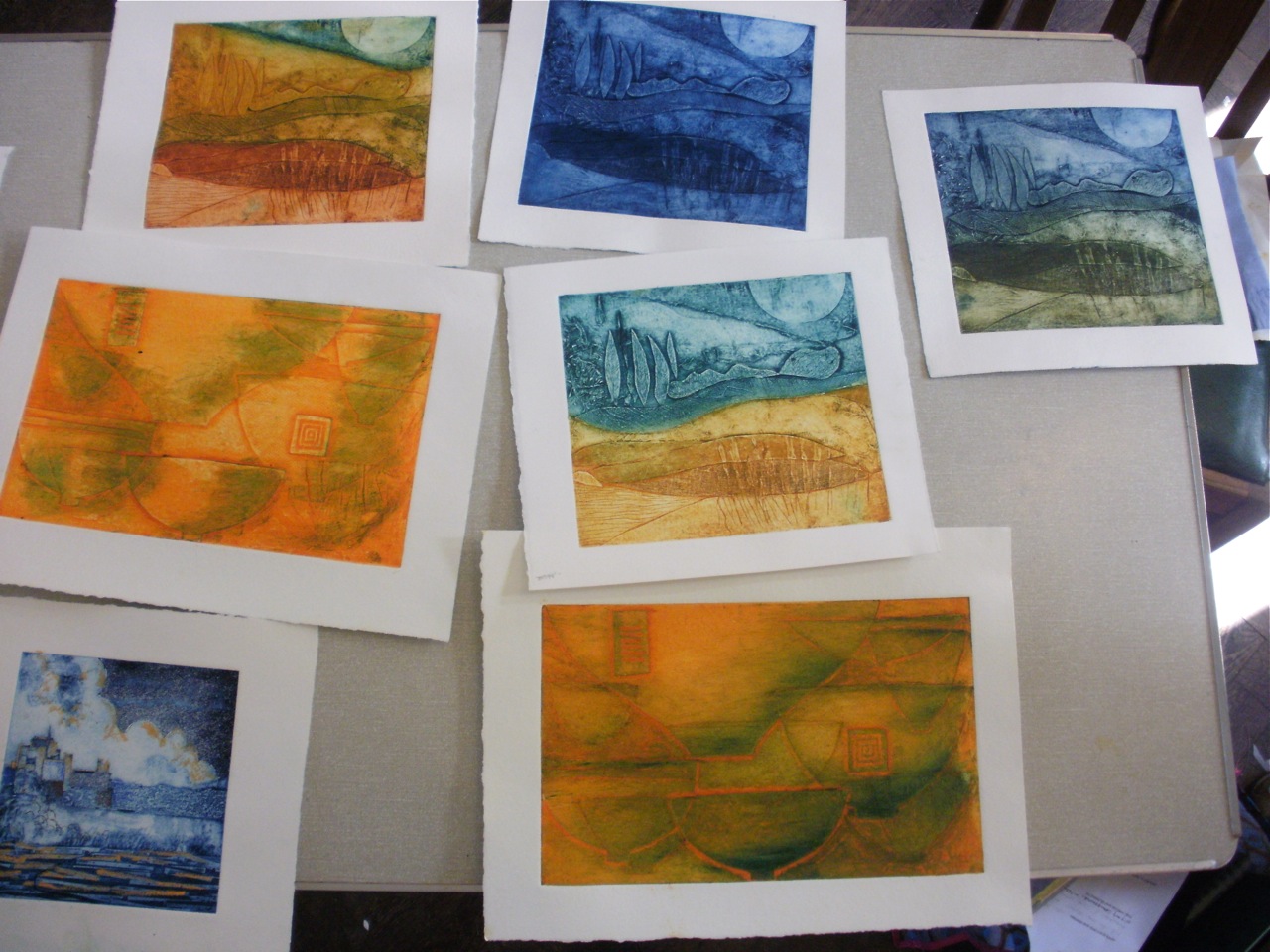
'Harvest moon 3' collagraph print © Mari French 2011

Harvest moon 3 (collagraph) © Mari French 2011

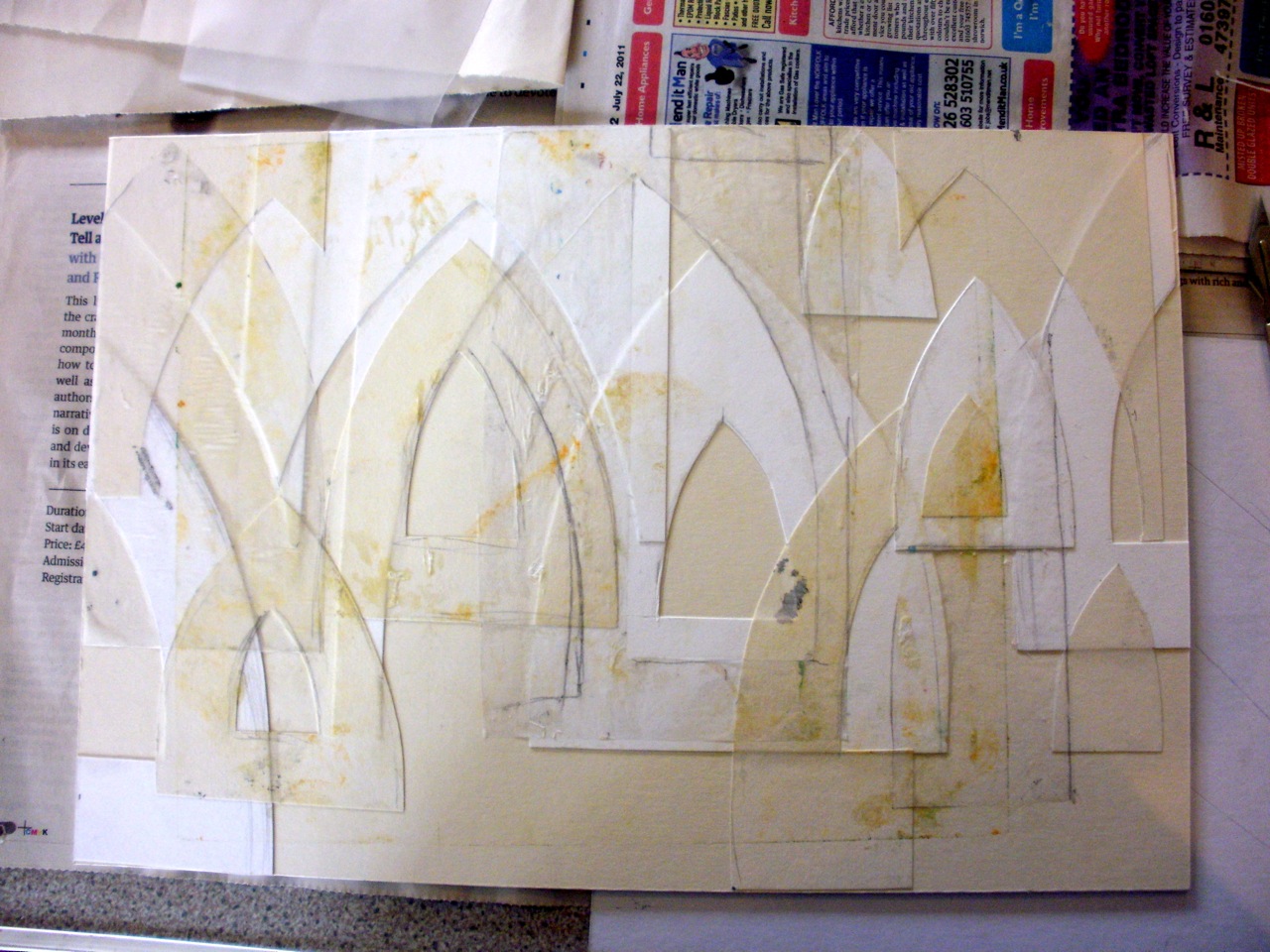
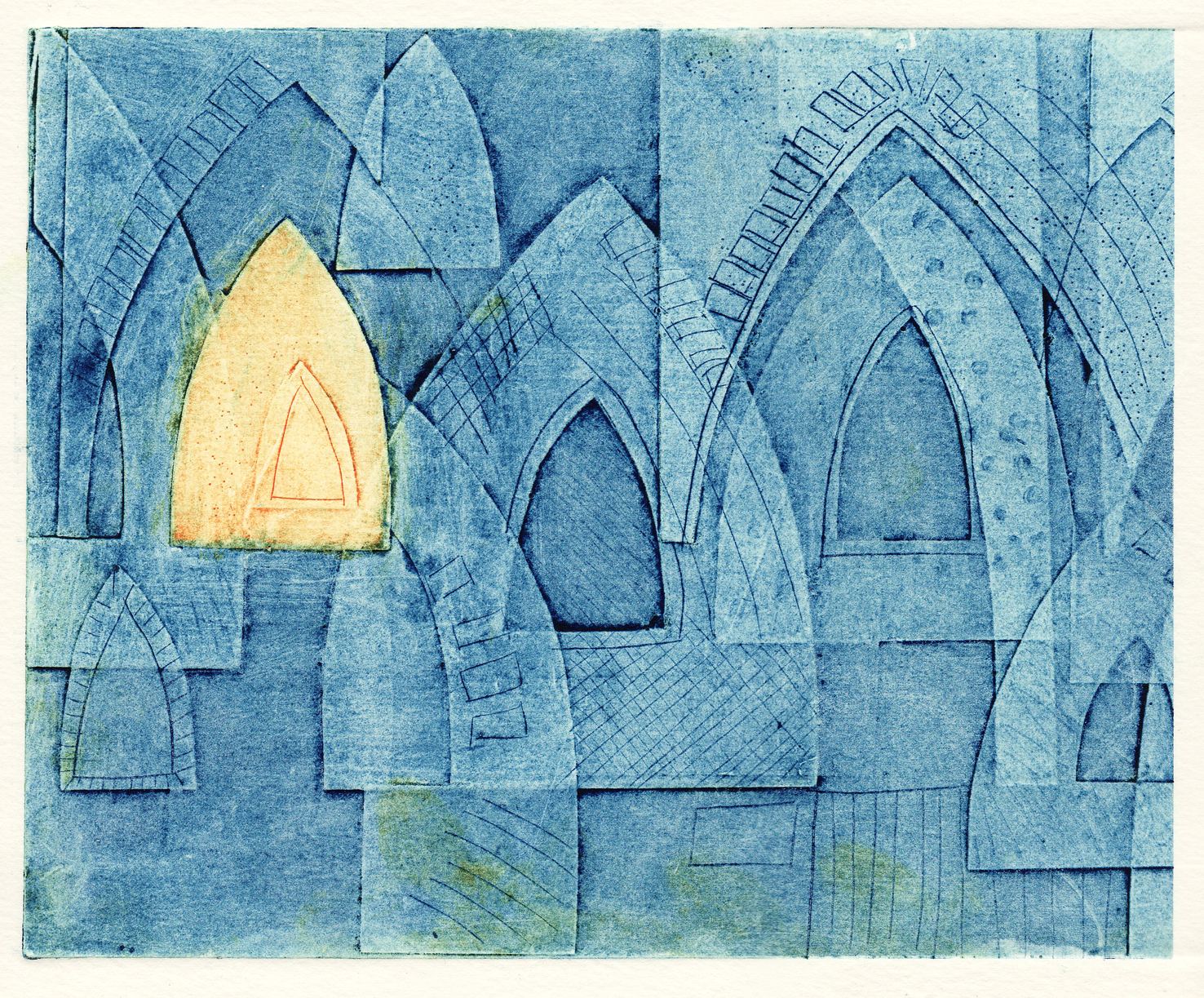
The method of building up overlapping layers, creating further shapes, is an alternative method of collagraph platemaking shown in the second ‘Arches’ plate below left.

simple layered collagraph plate (Arches © Mari French)

simple layered collagraph plate (Arches © Mari French)

I found it fascinating that by ‘playing’ around like schoolchildren with bits of paper, glue and scissors, it was possible to produce such creative prints.

Although most of the students on the workshop were artists or had some creative experience, none of them had made collagraphs before. Yet as you can see from the photos of some of their work further down this post, they produced some stunning collagraph prints.

Much of this was due to the encouragement, patience and experience of our tutor. Laurie Rudling also holds workshops at the Broadland Arts Centre at Dilham near North Walsham in Norfolk.
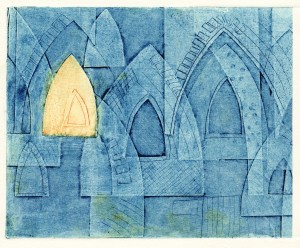
Arches (collagraph) © Mari French 2011

Arches (collagraph) © Mari French 2011

Poppy collagraph prints produced by fellow student Dee (photo © Mari French)

Poppy collagraph prints produced by fellow student Dee (photo © Mari French)

Collagraph workshop - students' work (photo © Mari French 2011

Collagraph workshop - students' work (photo © Mari French 2011)
evolution of a painting…

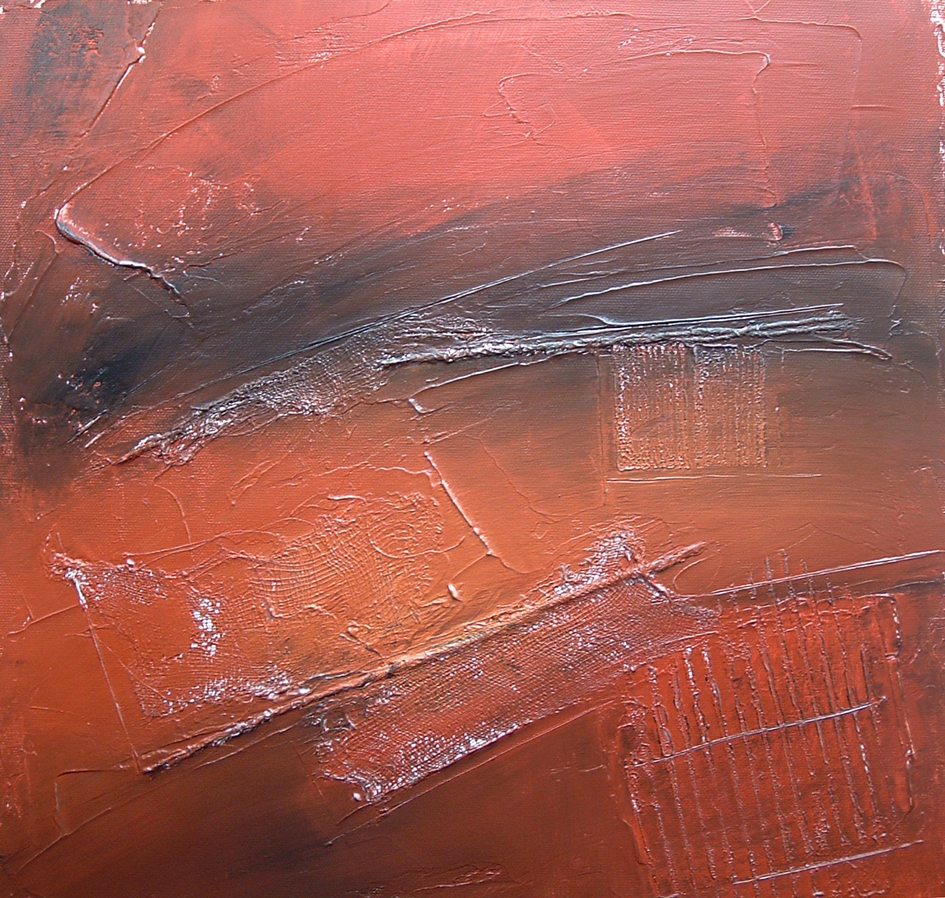
I recently came across these digital photos of the creation of a work I have on display at the Burnham Grapevine Gallery in North Norfolk just now. Titled simply ‘Red landscape’ it is approx 40x40cm, acrylic/mixed media on canvas like a lot of my work. I thought it might be interesting to show how the painting evolved.

step1 © Mari French 2009

step1 © Mari French 2009

Obviously step 1 above sees the work some way on in its progress. I started by covering the box canvas with a smooth texture paste that I use, spread liberally and loosely with a palette knife. Before this dried I embedded various materials into it such as fine muslin and string, also pressing pieces of corrugated cardboard (peeling off the covering layer on one side, revealing the ridges) to create interesting areas of texture. Then, using a large (4 inch) soft brush – I applied a mix of burnt sienna and yellow ochre mixed with matt medium all over. When that was almost dry, I swept paynes grey across parts of the upper middle and lower foreground, resulting in the above image (step 1).

step 2 © Mari French 2009

step 2 © Mari French 2009

In step 2 above, the sky area, horizon and foreground are suggested with parchment (a pale cream colour I find a bit gentler than white) giving some definition to what I could now visualise as a fieldscape, albeit an abstracted one. This was allowed to dry thoroughly.

step 3 © Mari French 2009

step 3 © Mari French 2009

Step 3 demonstrates the rather drastic technique I often use of sweeping darker paint over  the canvas with loose strokes concentrating on getting into all those bumps and ridges of texture. Before it dries I wipe most of it away with damp rags (have to be pretty quick here). Although this may seem a waste of time (and paint!) I find it gives a subtle depth to the final painting. Incidentally I use a hairdryer to speed up drying times for most works.

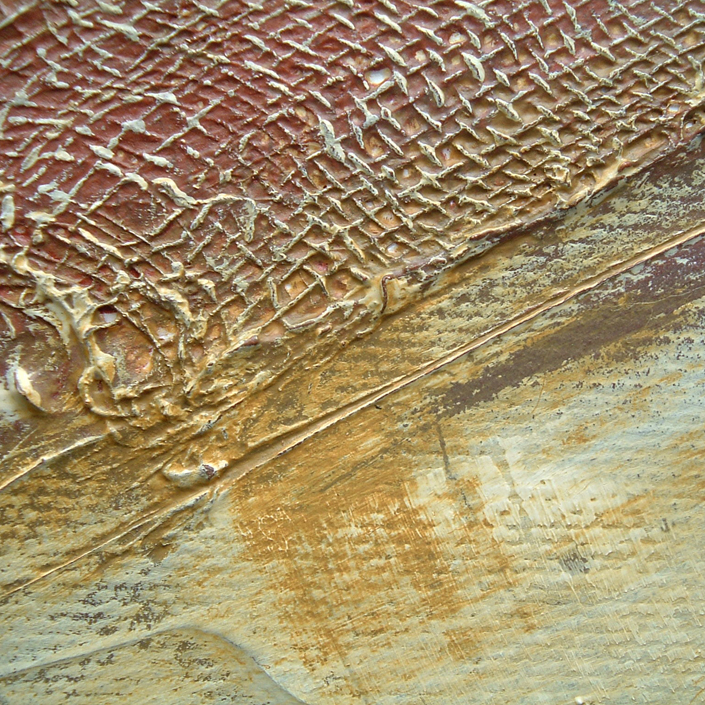
I then warmed up the painting with more burnt sienna and yellow ochre mix, and yellow ochre on its own, used fairly dry so it retained the brush strokes, to indicate ‘field’ areas. The finished work is shown below and also a close-up detail showing how the paint clings to the texture of the muslin etc.

Red landscape © Mari French 2009

Red landscape © Mari French 2009

'Red landscape' detail © Mari French 2009

'Red landscape' detail © Mari French 2009